
So many times I have heard horse owners say, “My horse looks like he is colicky so I gave him some Banamine. However, he still doesn’t look good.”
The first thing you should do before giving your horse medication is call your vet. And then of course give your horse what the vet prescribes.
But I bet almost all of you either have Banamine or Bute in your “at home” medicine cabinet for your horse. I have both in mine.
Most of the time we know when and how to use these on our horses but sometimes using the wrong one or the wrong amount can have catastrophic results. I’ve researched both of these to see which and when to use each one.
Both of these medicines can only be purchased legally with a vet’s prescription. But often you buy a bottle of one or the other and then don’t use it all. This means we have some left over to use later if we need it.
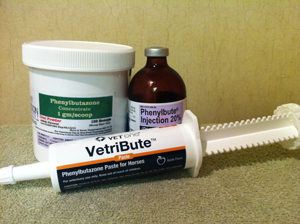
This works well if your vet can’t come out right away, as he can just tell you which one to use right away and how much to use. It can be very convenient as your horse may need it right away depending on his situation.
According to studies, the most common NSAID used in horses is Bute. The second most common is Banamine. They all have similar side effects but vary to different degrees. They both also are used to reduce pain and are anti-inflammatories.
But anti-inflammatory drugs do much more than simply control pain. They also reduce swelling and fever. They have value in treating a wide range of conditions in horses, from abdominal pain (colic) to joint injury and laminitis.
Even though they sound similar and seem like they could be used interchangeably because they both can be used for pain and inflammation, they are actually used for different situations.
NSAIDs include familiar human drugs like aspirin and ibuprofen. Less commonly used equine drugs in this class are firocoxib (Equioxx) ketoprofen, carprofen, naproxen, and many others.
This week we will discuss Bute and next week we will discuss Banamine.

Here is a quick summary:
BUTE (PHENYLBUTAZONE)
Bute is primarily used to relieve musculoskeletal pain and inflammation in the horse. It also comes in several forms including an injectable liquid for intravenous dosing only.
Used correctly, Bute is a powerful and effective means of relieving pain and inflammation. Nevertheless, there are potential side effects.
- Non-steroidal anti-inflammatory pain reliever.
- Bute can be given as a powder, paste, or via IV injection.
- Only veterinarians should give an IV injection, but never intramuscular.
- This anti-inflammatory is best for when your horse is sore or slightly off.
- Bute is highly effective for the treatment of lameness. As a consequence, it can mask signs of mild or moderate lameness. A horse with a serious musculoskeletal injury may over-exert, and thus worsen the injury.
- Standard doses for 1,000 lb horses are 2-4 grams per day and should be used for as few days as possible.
- Bute is processed, inactivated, and removed from circulation by the liver and kidneys. Young horses have not fully developed their ability to process this drug and tend to accumulate toxic doses of it. The same concern applies to horses with underlying kidney or liver disease.
- It’s best to use it periodically for minor aches and pains rather than in an everyday regimen.
- If your horse needs a pain reliever every day, talk to your vet about alternatives.
- Bute is unsafe in all horses at high doses for long periods of time.
- It should be avoided in horses with renal or GI disease and pregnant mares.
- Some horses are much more sensitive to Bute than others and may show side effects in smaller amounts.
- Bute is considered more likely to cause ulcers, especially in the large colon, than Banamine.
- Bute is somewhat less effective than Banamine at controlling abdominal pain (colic) but can still be useful.
General guidelines for using Bute:
- The best option is always for a veterinarian to examine any undiagnosed lameness or disease process.
- When you give a dose of Bute to a horse without veterinary oversight, recognize what you are doing. You are only temporarily relieving inflammation and pain, regardless of the diagnosis.
- If you do plan to use Bute to try to treat undiagnosed lameness, ask your vet for an appropriate dose for pain control and what to look for to determine treatment effectiveness.
- Confine any lame horse treated with Bute in a small area, to prevent worsening of injury due to overuse. Do not force exercise while on Bute.
- Do not use the injectable form of this drug because of the dangers of improper injection.
Well, this concludes the discussion about Bute. Next week we will discuss Banamine and my conclusions about the two.
Until then, Happy Horses and have a great weekend!
Very good topic as mostly if my horses seemed off, I called the vet. Before riding I always check how my horses walk and act to see if they favored any leg or anything seemed off. I’m always looking out for my horse and will call the vet if something is off.
Your horses are so lucky that you are so careful with your horses before and after riding. It makes a difference, especially to catch something early.
Thank you Teddie for this article.
I’m glad you enjoyed it. 🙂